
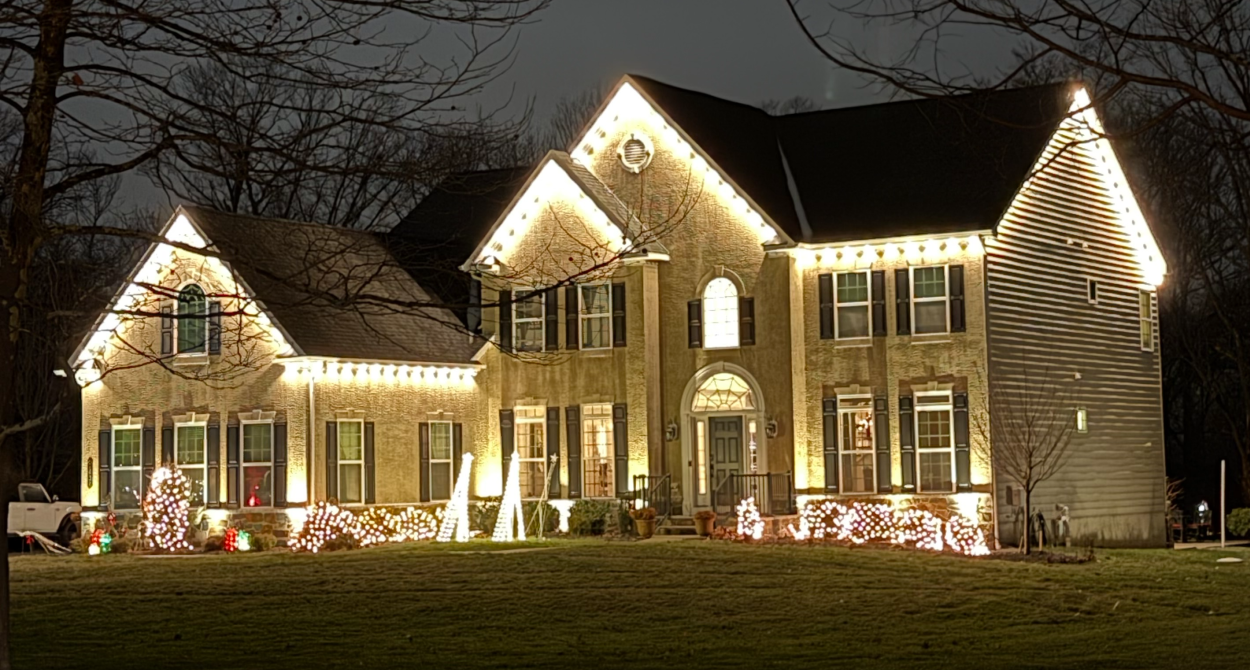
Every November, the same mistakes happen on thousands of homes across Southeast Pennsylvania. Some of them are small annoyances. Others cause gutter damage, insurance claims, or displays that looked nothing like what the homeowner had in mind. After years of professional holiday lighting installations across Montgomery, Chester, Bucks, Delaware, Berks, and Philadelphia County, the HP Lighting Solutions team at HydroPower has seen all of them. This post is an honest account of the seven most common holiday lighting mistakes and what a better approach looks like for each one.
Mistake 1: Waiting Until November to Think About It
This is the most common mistake and the one with the most downstream consequences. Homeowners who wait until early November to think about holiday lighting quickly discover that professional installation schedules are already filling, the best installation dates in the optimal pre-Thanksgiving window are often gone, and the design conversation gets compressed into whatever time is left before the scheduled installation date.
The practical fix is simple: decide in September whether you want professional lighting this year and book the consultation. HP Lighting Solutions and most professional holiday lighting companies in the region start taking bookings in late summer. September and early October bookings get the full calendar of available installation dates, unhurried design conversations, and none of the scheduling anxiety that comes with waiting.
If you are already in November reading this, call now rather than later. There may still be available dates, but they will not last long.
Mistake 2: Using the Wrong Clips for Your Gutter Type
Gutter clip selection is not one-size-fits-all, and using the wrong clip for your specific gutter profile is one of the most reliable ways to end up with strands that come loose mid-season, gutters that are distorted or scratched, or clips that snap in cold weather because the wrong plastic is under tension it was not designed to handle.
The most common gutter profiles in Southeast Pennsylvania, K-style and half-round, require different clip geometries. Add fascia-mounted gutters, box gutters, and various architectural gutters on older homes, and the selection gets more complicated. Retail holiday lighting displays typically sell a single clip type that is designed to work reasonably well on standard K-style gutters. If your home has anything else, that clip is either the wrong size or requires enough force to install that it risks damaging the gutter in the process.
Professional installers select hardware specifically matched to your gutter type, which is why professional installations hold through an entire season without strands sagging, spacing drifting, or hardware failing in cold weather. If you are installing your own lights, spend a few minutes identifying your gutter profile and researching the clip designed specifically for it before buying a bag of whatever is on the display rack.
Mistake 3: Overloading Circuits
Holiday lighting trips more residential circuit breakers in November and December than any other single cause, and the reason is almost always the same: too many strands connected in series on a single circuit, often combined with other holiday decorations, an outdoor extension cord that is undersized for the load, and an outdoor GFCI outlet that was not designed to handle extended high-load operation in wet weather.
Each string of LED holiday lights draws significantly less current than incandescent strings, which has led many homeowners to connect far more strands than they would have with older incandescent products. But LED strings still draw current, and the manufacturer limits on series connections per circuit apply regardless of bulb type. Exceeding those limits means tripped breakers, and in worst-case scenarios, it means overheated wiring in extension cords and outdoor connections that create a fire risk.
The practical guidance: follow the manufacturer’s maximum connection limits on every strand, use outdoor-rated extension cords sized appropriately for the load, and make sure multiple display zones are served by separate circuits rather than everything running through one outdoor outlet. If your home’s outdoor electrical is not set up for a large holiday display, an electrician can add circuits far less expensively than the alternative of discovering the problem mid-season.
Mistake 4: Ignoring the Takedown Plan Until January
Every homeowner who has pulled a bin of tangled, cracked, half-working lights out of the garage in October knows this mistake firsthand. Holiday lighting takedown and storage are the parts of the process that get least attention during installation and create the most frustration the following year.
Lights that are removed quickly, coiled roughly, and stuffed into a bin through the cold of January arrive next November in significantly worse shape than lights that were removed carefully, labeled by zone, coiled by strand length, and stored in a temperature-stable environment. Retail lights stored through a Pennsylvania summer in a hot garage, followed by a winter in an uninsulated space, will show it. Wiring insulation becomes brittle, connections degrade, and strands that worked fine in December no longer work reliably the following fall.
Professional holiday lighting programs solve this entirely. HP Lighting Solutions handles all takedown at the end of the season, stores materials at our facility in controlled conditions, and brings everything back the following year ready to install. No garage bins, no tangled strands, no discovering in November that half of what you thought you had is no longer working.
Mistake 5: Designing for the Installation, Not the View from the Street
Holiday lighting is meant to be seen from the street, from a distance, in the dark. This seems obvious, but it is surprisingly common for homeowners to design and install a display that looks intentional up close and inconsistent or patchy at 50 feet in the dark.
The most common version of this mistake is uneven coverage: a roofline that is fully lit on the front face but drops off at the corner returns, trees that are partially wrapped, or areas where the strand count changes noticeably mid-roofline. These transitions are hard to see from a ladder during installation and very easy to see from the street on the first night the lights go on.
Designing with the street view in mind means planning coverage to the full extent of each architectural feature, matching strand density consistently across the entire display, and walking out to the street during the design phase to evaluate what will actually be visible. Professional installers do this systematically. For homeowners working on their own, physically standing at the end of your driveway and looking at your roofline before installation begins is the simplest way to plan a display that looks finished rather than partial.
Mistake 6: Choosing the Wrong Color Temperature for Your Home
Warm white, cool white, and pure white are three meaningfully different light colors that look dramatically different on different home exterior finishes, and getting this choice wrong is one of the most visible and hardest to fix mistakes in holiday lighting. Warm white lights on a home with gray or blue-toned exterior siding can create an odd color cast. Cool white on a traditional brick colonial can look clinical rather than festive. Pure white on a home with warm cream or tan tones can make the exterior appear washed out.
The best way to choose is to look at photos of your home’s exterior in natural daylight and consider what color temperature complements the dominant tones of the siding, brick, stone, or stucco. Warm white, typically in the 2700K to 3000K range, complements warm-toned and traditional exteriors. Cool white, in the 4000K to 5000K range, works well on contemporary homes with cooler gray, white, or charcoal exteriors. When in doubt, warm white is the more forgiving and classically festive choice for most homes in Southeast Pennsylvania.
During a professional design consultation, HP Lighting Solutions brings sample light types and color temperatures to your home and evaluates them against your specific exterior before making a recommendation. It is one of the less obvious advantages of working with professionals, and it consistently produces results that homeowners are significantly happier with than what they would have picked off a shelf.
Mistake 7: Skipping the Test Before the Display Goes Up
Testing every strand before installation is one of the simplest, most consistently skipped steps in DIY holiday lighting. The math is straightforward: a strand that tests perfectly in October, sits in a bin through November, and is then installed on a cold roofline in early November may not perform the same way. Wiring connections that were reliable in the garage reveal problems when exposed to cold, tension, and weather.
Testing each strand fully uncoiled before installation, rather than after everything is clipped and strung, saves a significant amount of time and frustration. A strand that fails after installation requires either removing and replacing it, which means disturbing neighboring strands and clips, or accepting a dark section in your display that will bother you every night until January.
For homeowners doing their own installation, the test-before-install step is non-negotiable. For professional installation, your lighting company should be testing materials as part of their process. Ask HP Lighting Solutions or any professional you are evaluating whether strand testing is included in their installation workflow. The answer should be yes.
Avoid All of It
The fastest and most reliable way to avoid every mistake on this list is to work with a professional. HP Lighting Solutions by HydroPower handles the design, the hardware selection, the installation, the circuit management, the in-season maintenance, and the takedown and storage. None of the seven mistakes above are possible when a professional crew is doing the work correctly. And the result on your home will look better than anything you produce on your own with a ladder and a bin of retail lights.